LATEST CARS GALLERY
LATEST CARS NEWS
Showing posts with label Porsche. Show all posts

Wednesday, September 21, 2011

2012 Porsche Cayenne comes with bi-xenon headlights

The Red Porsche Cayenne
The Porsche Cayenne S and turbo are fitted with 18 inch wheels and the new Cayenne GTS with 21 inch wheels, whereas the base Cayenne has 17 inch wheels standard. The engines of the Porsche Cayenne's different variations feature a high pressure fuel management system that uses direct injection. This system is said to offer a reduction in the consumption of fuel. The base Cayenne has a 3.6 liter, narrow angle V6 engine with 290 horsepower. The Cayenne S has a 4.8 liter V8 engine that gives 385 horsepower.

The Cayenne Turbo boasts a twin turbo V8 engine giving 500 horsepower. The Cayenne GTS has V8 engine that produces 405 horsepower. The Porsche Cayenne Turbo powers through 0-60 mph in 4.9 seconds, the V6 Cayenne does it in 7.5 seconds reaching speeds of over 140 mph. The cayenne GTS will get to 60 mph in just under 6 seconds attaining speed of just under 160 mph. The latest Cayenne models can all be had with a six speed transmission both manual and automatic. Mileage rating is expected to improve to 15 percent.
2012 Porsche Cayenne Interior

2012 Porsche Cayenne
The new model will come with a body control suspension as an option, and the Dynamic Chassis Control employs anti roll bars to counter body roll and makes handling better. As basic features the Porsche Cayenne comes with bi-xenon headlights and a partition net and rail system as part of the cargo compartment floor. There is however limited cargo space. The safety equipment is also standard and includes skid control, airbags, and roll over sensors.
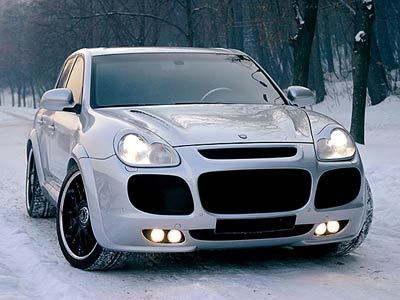
2012 Porsche Cayenne though is powered by a VR6 derived engine

Though critics have knocked the fact that the sporty posh car maker has been dabbling in SUVs, they may close their lips after seeing the new 2011 Porsche Cayenne.

One of the most noticeable changes is the drive. In earlier models, the critics were right, Porsche's SUVs were heavy and didn't have the smooth drive that Porsche owners covet. But they have learned a lot since their first trial in 2003, and have even gone leaps and bounds from last year's model.
Gemballa Porsche Cayenne - Territorium
The base model Porsche Cayenne though is powered by a VR6 derived engine, which is the same unit that powers the above mentioned VW Touareg as well as the Volkswagen Golf R32. It produces around 250 horse power which is good enough the get the rather large and heavy Porsche Cayenne from rest to 100 kph (62 mph) in around 7.5 seconds.

However, as Porsche are not necessarily known for their slow cars, there are other options available. The next step up is the Porsche Cayenne S. This version has a V8 engine delivering 340 horse power. This decreases the sprint time from the above 7.5 seconds to a more respectable 6.4 seconds with a top speed of 155 mph.

After that there is the Porsche Cayenne GTS which houses a 4.8 litre V8 engine which produces 405 horse power. The sprint time consequently drops again to now below 6 seconds at 5.7 seconds.
Filed under: Porsche | suv | Porsche Cayenne | luxury cars

Thursday, September 15, 2011

2012 Porsche 911 officially launched at Frankfurt


Porsche has unveiled the 2012 911 (991) at the Frankfurt Motor Show.

Arguably the biggest bit of news regarding the 2012 911 is its seven-speed manual transmission, available with both the 3.4-liter and 3.8-liter flat-six engines. That, combined with start/stop technology means the new 911 will be more efficient than ever, though its impressive output numbers (300 horsepower for the 3.4-liter mill, 400 hp for the 3.8) mean it'll still be an excellent enthusiast machine out on the road. Porsche claims 0-60 times of 4.4 seconds for the base Carrera and 4.1 seconds for the Carrera S.


2012 Porsche 9112012 Porsche 9112012 Porsche 9112012 Porsche 9112012 Porsche 9112012 Porsche 9112012 Porsche 9112012 Porsche 911


Press Release

World premiere at the 2011 IAA Frankfurt Motor Show

The new Porsche 911 Carrera: Tradition meets modernity


Stuttgart. At 48, the Porsche 911 Carrera is younger than ever: The completely redesigned generation of the sports car icon is stepping into the limelight with its flat, stretched silhouette, exciting contours and precisely designed details, yet from the very first glance it remains unmistakably a 911. True to the 911 tradition, the distinctive Porsche design language with its tendons and muscles exudes power and elegance.

The 100 millimetre (~ 3.9 inches) longer wheelbase and reduced height combined with the up to 20-inch wheels underpin the athletic appearance. At the same time, the typical sports car compact exterior dimensions were retained. Seen from the front, the eye is drawn to the 911's trademark wide-arched wings. They emphasise the wider front track, so that the new 911 Carrera models sit even more solidly on the road. The remodelled exterior mirrors are accommodated on the upper edge of the door and not as before on the mirror triangle. Not only is this aerodynamically advantageous, it also emphasises the new design line and visual impression of width.

The all-new, lightweight body is an intelligent aluminium-steel construction. It is responsible for a significant proportion of the weight reduction of up to 45 kilograms. Combined with significantly greater rigidity. Aerodynamic optimisation - including a wider, variably extending rear spoiler - enabled the new 911 Carrera's lift to be reduced yet further while retaining a very good Cd value.

To complement the modern exterior design, the Porsche designers created an interior, the architecture of which takes its cue from the Porsche Carrera GT. The driver is now even more closely integrated with the cockpit thanks to the centre console rising up to the front with the high-mounted shift lever or gear selector located especially close to the steering wheel in typical motorsport fashion. Classic Porsche elements are also to be found inside, as they are on the outside: the instrument cluster with five round instruments - one of them a high resolution multifunction screen, the central rev counter and the ignition lock to the left of the steering wheel.

Setting the standard in its class, as it has for generations, the new 911 Carrera and Carrera S raise the performance and efficiency bar yet another notch. All versions get by with significantly less than ten litres of fuel per 100 kilometres (28 mpg imp.). Fuel consumption and emissions are up to 16 per cent lower compared with its predecessor. Among other things, this is achieved by systems and functions such as auto start/stop, thermal management, electrical system recuperation, the world's first seven-speed manual transmission and - in conjunction with the Porsche-Doppelkupplungsgetriebe (PDK) - sailing as it is called. The new electro-mechanical power steering offers not only Porsche's typical precision and feedback but also helps to increase efficiency and reduce fuel-consumption.

For example, the 911 Carrera with the new 350 hp (~ 257 kW) 3.4-litre boxer engine and optional PDK consumes a mere 8.2 litres per 100 kilometres (~ 34 mpg imp.) based on the New European Driving Cycle (NEDC) - 1.6 l/100 km (~ 6 mpg imp.) less than its predecessor. Also, at 194 g/km CO2, it is the first Porsche sports car to make it below the 200 g/km mark. With the 911 Carrera S as well, with its 3.8-litre boxer engine and what is now 400 hp (~ 294 kW), fuel consumption when paired with the optional PDK is reduced by 14 per cent or 1.5 l/100 km (~ 5 mpg imp.) to 8.7 l/100 km (~ 32 mpg imp.) despite 15 hp (~ 11 kW) more power. That equates to CO2 emissions of 205 g/km.

At the same time there are performance improvements in both models. The 911 Carrera S with PDK manages to accelerate from nought to 100 km/h (~ 62 mph) in 4.3 seconds. Pressing the Sport Plus button on the optional Sport Chrono package cuts that to 4.1 seconds. The 911 Carrera with PDK needs only 4.6 seconds (Sport Plus 4.4 seconds) to sprint from a standing start to 100 km/h (~ 62 mph).

The new 911 doesn't just offer better longitudinal dynamics, however, but top performance at an unprecedented level in terms of transverse dynamics as well. In addition to the longer wheelbase, the greater agility, precision and driving stability are based, among other things, on the wider front track, the new rear axle and new electro-mechanical power steering. Depending on the model, there are other standard or optional active control systems available as well that further enhance the driving dynamics. That is especially true for the Porsche Dynamic Chassis Control (PDCC) active roll stabilisation system, available for the first time on the 911 Carrera S. For example, the system reduces lateral inclination when cornering, the tyres always being in the optimal position relative to the road surface and able to transmit higher lateral forces. Maximum cornering speeds are increased; even faster lap times on racing circuits are possible.

It has therefore been possible in the new model to extend yet further the span of apparently contradictory attributes such as performance and efficiency, sportiness and everyday practicality that has always typified the Porsche 911. That makes the 911 Carrera more of a 911 than ever. The new Porsche 911 Carrera celebrates its world premiere at the 2011 IAA Frankfurt Motor Show. The launch of the new 911 models gets under way on 3 December 2011, the new cars can be orderd from September 1st. Prices in Germany are 88,038 euro for the 911 Carrera and 102,436 euro for the 911 Carrera S, including 19 per cent VAT and market-specific equipment.

Wednesday, August 24, 2011

Frankfurt Preview: 2012 Porsche 911

http://1.bp.blogspot.com/-I6qHVXa2C7Y/TkxPhmKsXhI/AAAAAAAE3sM/_QXDPMdL338/s1600/2012-Porsche-911-5.jpg


Porsche has released the 2012 911 sports coupe,which will make its debut at the Frankfurt motor show on September 13.


The new 911 is distinguished by larger LED headlamps fitted with new internal graphics and more pronounced front fenders housing a wider front track. It also receives a longer hood and an altered front apron with larger air ducts for more efficient cooling. Down the sides there are larger exterior mirrors mounted on the doors rather than within the blanked-off area in front of the side windows, and added sculpturing to the area beneath the doors. The rear gets new LED taillamps that wrap farther around in the sides than before and a heavily revised rear wing that is claimed to provide added levels of downforce. Despite the evolutionary approach to the styling, the new car looks more contemporary than ever before.


Powering this more lightweight 911 is a pair of new horizontally opposed flat-six-cylinder engines. The base Carrera gets a 350-horsepower, 3.4-liter boxer engine mated to a first-of-its-kind seven-speed manual transmission. There�s also an optional seven-speed dual-clutch automatic transmission that was available on the 2011 model. The Carrera�S gets a 400-hp, 3.8-liter boxer engine with the same transmission options. With the automatic transmission, the 3.4-liter can accelerate from zero to 60 mph in 4.6 seconds (about a tenth of a second faster than 2011 equivalent), while the 3.8-liter Carrera S can do it in 4.3 seconds (0.2 seconds faster).


Prices in Germany will start at �88,038 for the 911 Carrera and �102,436 for the Carrera S, VAT included. In the United Kingdom 911 models will be in Porsche Centers from December 17, 2011 at �71,449 and �81,242, respectively. Prices in the U.S. are listed at a base MSRP of $82,100 and $96,400 (excluding destination).


2012 Porsche 911 2012 Porsche 911 2012 Porsche 911 2012 Porsche 911 2012 Porsche 911 2012 Porsche 911 2012 Porsche 911


Press Release


World premiere at the 2011 IAA Frankfurt Motor Show


The new Porsche 911 Carrera: Tradition meets modernity


At 48, the Porsche 911 Carrera is younger than ever: The completely redesigned generation of the sports car icon is stepping into the limelight with its flat, stretched silhouette, exciting contours and precisely designed details, yet from the very first glance it remains unmistakably a 911. True to the 911 tradition, the distinctive Porsche design language with its tendons and muscles exudes power and elegance.


The 100 millimetre (~ 3.9 inches) longer wheelbase and reduced height combined with the up to 20-inch wheels underpin the athletic appearance. At the same time, the typical sports car compact exterior dimensions were retained. Seen from the front, the eye is drawn to the 911's trademark wide-arched wings. They emphasise the wider front track, so that the new 911 Carrera models sit even more solidly on the road. The remodelled exterior mirrors are accommodated on the upper edge of the door and not as before on the mirror triangle. Not only is this aerodynamically advantageous, it also emphasises the new design line and visual impression of width.


The all-new, lightweight body is an intelligent aluminium-steel construction. It is responsible for a significant proportion of the weight reduction of up to 45 kilograms. Combined with significantly greater rigidity. Aerodynamic optimisation - including a wider, variably extending rear spoiler - enabled the new 911 Carrera's lift to be reduced yet further while retaining a very good Cd value.


To complement the modern exterior design, the Porsche designers created an interior, the architecture of which takes its cue from the Porsche Carrera GT. The driver is now even more closely integrated with the cockpit thanks to the centre console rising up to the front with the high-mounted shift lever or gear selector located especially close to the steering wheel in typical motorsport fashion. Classic Porsche elements are also to be found inside, as they are on the outside: the instrument cluster with five round instruments - one of them a high resolution multifunction screen, the central rev counter and the ignition lock to the left of the steering wheel.


Setting the standard in its class, as it has for generations, the new 911 Carrera and Carrera S raise the performance and efficiency bar yet another notch. All versions get by with significantly less than ten litres of fuel per 100 kilometres (28 mpg imp.). Fuel consumption and emissions are up to 16 per cent lower compared with its predecessor. Among other things, this is achieved by systems and functions such as auto start/stop, thermal management, electrical system recuperation, the world's first seven-speed manual transmission and - in conjunction with the Porsche-Doppelkupplungsgetriebe (PDK) - sailing as it is called. The new electro-mechanical power steering offers not only Porsche's typical precision and feedback but also helps to increase efficiency and reduce fuel-consumption.


For example, the 911 Carrera with the new 350 hp (~ 257 kW) 3.4-litre boxer engine and optional PDK consumes a mere 8.2 litres per 100 kilometres (~ 34 mpg imp.) based on the New European Driving Cycle (NEDC) - 1.6 l/100 km (~ 6 mpg imp.) less than its predecessor. Also, at 194 g/km CO2, it is the first Porsche sports car to make it below the 200 g/km mark. With the 911 Carrera S as well, with its 3.8-litre boxer engine and what is now 400 hp (~ 294 kW), fuel consumption when paired with the optional PDK is reduced by 14 per cent or 1.5 l/100 km (~ 5 mpg imp.) to 8.7 l/100 km (~ 32 mpg imp.) despite 15 hp (~ 11 kW) more power. That equates to CO2 emissions of 205 g/km.


At the same time there are performance improvements in both models. The 911 Carrera S with PDK manages to accelerate from nought to 100 km/h (~ 62 mph) in 4.3 seconds. Pressing the Sport Plus button on the optional Sport Chrono package cuts that to 4.1 seconds. The 911 Carrera with PDK needs only 4.6 seconds (Sport Plus 4.4 seconds) to sprint from a standing start to 100 km/h (~ 62 mph).


The new 911 doesn't just offer better longitudinal dynamics, however, but top performance at an unprecedented level in terms of transverse dynamics as well. In addition to the longer wheelbase, the greater agility, precision and driving stability are based, among other things, on the wider front track, the new rear axle and new electro-mechanical power steering. Depending on the model, there are other standard or optional active control systems available as well that further enhance the driving dynamics. That is especially true for the Porsche Dynamic Chassis Control (PDCC) active roll stabilisation system, available for the first time on the 911 Carrera S. For example, the system reduces lateral inclination when cornering, the tyres always being in the optimal position relative to the road surface and able to transmit higher lateral forces. Maximum cornering speeds are increased; even faster lap times on racing circuits are possible.


It has therefore been possible in the new model to extend yet further the span of apparently contradictory attributes such as performance and efficiency, sportiness and everyday practicality that has always typified the Porsche 911. That makes the 911 Carrera more of a 911 than ever. The new Porsche 911 Carrera celebrates its world premiere at the 2011 IAA Frankfurt Motor Show. The launch of the new 911 models gets under way on 3 December 2011, the new cars can be orderd from September 1st. Prices in Germany are 88,038 euro for the 911 Carrera and 102,436 euro for the 911 Carrera S, including 19 per cent VAT and market-specific equipment.


Wednesday, August 3, 2011

2012 Porsche 911 GT3 Cup

https://blogger.googleusercontent.com/img/b/R29vZ2xl/AVvXsEiC9-l-zy6MXJHn9-Zq18wlPq9T_isWqjnO8yDVXhMwJUlWUd9ZNsLVtNZlaqp7SPfcUw9VTSOUMA76z53dzCBqtIB2V8jcZHSOXQeFfeoOwIOTFG4LLcXsQNM9Ock6rOsPOfNVWOY190Y/s1600/2012-porsche-911-gt3-cup_100358050_m.jpg

Porsche has releases photos and specifications for the 2012 911 GT3 Cup.

The 2012-spec Porsche 911 GT3 Cup is based on the lightweight 911 GT3 RS (997) street sports car. The power unit is largely identical to the production engine of the 911 GT3 RS with the same output of 450bhp and the same maximum engine torque of 8,500rpm.

The 2012 Porsche 911 GT3 Cup comes equipped with a controlled catalytic converter, flared wheel arches, 9.5Jx18 rims with 25/64-18 Michelin race tires at the front and 12Jx18 wheels with 30/68-18 tires at the rear. Porsche also fitted the 2012 911 GT3 Cup with adjustable blade-type anti-roll bars at the front and rear, PCCB Ceramic Composite brakes, and a special steering wheel with six switches for controlling various settings of the car.

The new Porsche 911 GT3 Cup will be delivered to teams around the world from September and will be run in this specification for the 2012 and 2013 race seasons in selected one-make cup series. The price is 161,750 Euro plus value-added tax of the respective countries.


2012 Porsche 911 GT3 Cup 2012 Porsche 911 GT3 Cup 2012 Porsche 911 GT3 Cup 2012 Porsche 911 GT3 Cup 2012 Porsche 911 GT3 Cup


Press Release

Most successful race car now suitable for wider range of motorsport


Stuttgart. It is the most successful race car on earth: The Porsche 911 GT3 Cup. With over 2,200 units sold, it is the undisputed number one amongst customer racing teams all over the world. Now, the new 911 GT3 Cup features a 100-litre FT3 safety fuel tank, which is filled via an opening in the front bonnet. Compared to its predecessor, the vehicle is now suitable for an even wider range of endurance racing. Moreover, the new fuel tank contributes to a further improvement of the high safety standards.

The 2012-spec Porsche 911 GT3 Cup is based on the lightweight 911 GT3 RS (997) street sports car. The power unit is largely identical to the production engine of the 911 GT3 RS with the same output of 450 bhp and the same maximum engine speed of 8,500 rpm. A race exhaust system with a controlled catalytic converter keeps emissions to a minimum.

The flared wheel arches at the front axle accommodate light alloy rims measuring 9.5Jx18 with 25/64-18 Michelin race tyres. The light alloy rims at the rear measure 12Jx18 with 30/68-18 tyres. Depending on the type of racing, the new 911 GT3 Cup features different rim specifications. The blade-type anti-roll bars at the front and rear are adjustable in seven positions allowing an extremely precise set-up for each race track. Exclusive to the Porsche Mobil1 Supercup which runs as support to Formula 1 is the PCCB Porsche Ceramic Composite Brake. This is also available for Porsche's road models. Compared to the composite cast brakes in the Carrera Cups and the GT3 Cup Challenges, PCCB reduces the weight of the car by around 20 kilograms.

The cockpit of the new 911 GT3 Cup caters for the needs of the driver. The controls for the info display are positioned on the steering wheel which houses six switches. As in the production car, the reach and height of the steering wheel can be adjusted.

The new Porsche 911 GT3 Cup will be delivered to teams around the world from September and will be run in this specification for the 2012 and 2013 race seasons in selected one-make cup series. The price is 161,750 Euro plus value-added tax of the respective countries.

Currently, the 911 GT3 Cup competes in 19 Porsche brand trophy series worldwide. Moreover, it is run in various GT race series and at long distance events. The 911 GT3 Cup is the basis model of Porsche's racing vehicle range. Additionally, Porsche Motorsport offers the 911 GT3 R for championships complying with GT3 regulations and the 911 GT3 RSR built according to GT2 rules.

Saturday, June 11, 2011

2012 VW Beetle with Porsche Styling

https://blogger.googleusercontent.com/img/b/R29vZ2xl/AVvXsEgG-ITA0PazhLz9hxnbosaIqN_Te3KUNC7fuKDvioWgIPcM37dcGDSkR-40eGX0UnQl4ejAPlEaAGWm1C2gVILP1Y52Gn_EuWmcuCanWEE5y4EPRlcYlVR4vXovs0BaAXCezJ1WkAyjH2eS/s1600/VWvortex-2012-Beetle-RS-Stage-1_02.jpg

VW beetle is new generation of Beetle car. This car has its debut on the Shanghai Auto Show and in the New York Auto Show.

new 2012 Volkswagen Beetle will come in 2012 here the 2012 Volkswagen Beetle Modification Inspired by the Porsche 911 GT3 RS. Of course it will interesting when this Beetle one of new product of Volkswagen and now the modification has ready exist. The design try to follow Porsche 911 GT3 RS that has luxury design and concept. So as a car lover, you might love this Beetle as one of Best Modification of Volkswagen Product.

The exterior makeup is limited for now to Beetle RS graphics finished in orange on either side of the car, the blacked out chrome strips on the lower part of the doors and the front grille, plus the 3M Titanium Brushed wrap for the rear VW logo. The team�s next upgrade will include a 997 GT3 RS-style rear wing.

With the big wheels installed, the front brakes really looked tiny. So we called our friends at APR and ordered up a set of Brembo Stage II front brakes. The kit includes 14" front two-piece cross drilled rotors, four-piston radial mount calipers, aluminum mounting brackets, stainless braided lines and pads. These too bolted right up with no issues and look great filling up the front wheels.


Sunday, May 22, 2011

Porsche Boxster E Prototypes

http://1.bp.blogspot.com/-1z1aQG93LyM/Tduvy5-8s6I/AAAAAAAEcuo/1BuRYm8GqO0/s1600/Porsche-Boxster-E-4.jpg

The Michelin Challenge Bibendum is an annual event run by the French tire company aimed at promoting the development of sustainable mobility. At this year�s event in the German capital of Berlin Porsche rolled out its Boxster E electric car prototype, revealing a few more saucy details about its testing schedule and zero-emission future.

In total, Porsche had three Boxster E models which weren�t just on display, but were available (to a select few) to be driven around a course. While two of the prototypes feature a traditional Boxster rear-drive layout Porsche has also built an electric AWD version.

The Porsche Boxster E is equipped with a 90kW motor (about 120 hp), while torque is about 270 Nm. Performance stats are 0-100 km/hr in 9.8 seconds. That is significantly slower than the traditional Boxster�s 6.5 seconds. If that�s not enough for traditional Porsche enthusiasts, the company has worked on a solution of offering two motors totalling 240 hp and torque of 540 Nm. In that set-up, acceleration is down to about 5.5 seconds.
Each of the battery�s cells has a nominal voltage of 3.3 V and an individual capacity of 20 Ah. Its energy content is 29 kWh of which approximately 26 kWh are available for use. Its maximum power output is 240 kW, or 60 kilowatts more than the all-wheel drive Boxster E draws under full load. The battery and power unit components are connected to two water cooling circuits.

All three prototypes are outfitted with ceramic composite regenerative brakes, an electric air conditioner, a revised instrument cluster and an active sound system that provides drivers with acoustic feedback.�


Porsche Boxster EPorsche Boxster EPorsche Boxster EPorsche Boxster E


Press Release

Boxster E prototypes attract many prospective customers


Stuttgart. The two Boxster E prototypes which Porsche showed off at the Michelin Challenge Bibendum in Berlin last week have proved to be a real attraction to the public. At this forum for sustainable mobility, which was staged for the eleventh time this year, representatives from politics, industry, trade and research discussed the environmentally-friendly mobility and vehicle concepts of the future. The trips in the electric Boxsters were in particular demand amongst the expert audience. On a sporty circuit, the vehicles demonstrated that a Boxster with electric drive still remains a genuine Porsche in terms of driving dynamics. In the wake of the GT3 R Hybrid, 918 Spyder and 918 RSR, the Boxster E is yet another sports car concept exhibiting the brand's characteristic combination of research and driving pleasure.

The Boxster E, with one electric motor apiece on front and rear axle, runs on purely electric power with four-wheel drive and is equivalent to a Boxster S in terms of driving dynamics. Together with two other Boxster Es, in which an electric motor drives the rear wheels, the prototype is being used to explore the everyday practicality of all-electric vehicles and how they are used, especially in terms of driving and battery charging. What the researchers are after is an understanding of the requirements facing future products, where to go next with Porsche Intelligent Performance and how to integrate electric vehicles into the infrastructure.

The practical trials with the three Boxster Es are part of the "Model Region Electro-Mobility Stuttgart" large-scale trial. The Stuttgart model region is being sponsored as part of the Federal Government's "Electro-Mobility in Model Regions" project. The Federal Ministry of Transport, Building and Urban Development (BMVBS) is making approximately 130 million euro available from the Federal Government's economic stimulus package II for eight model regions nationwide. The project is being coordinated by NOW GmbH, the National Organisation for Hydrogen and Fuel Cell Technology.

Thanks to its design as a mid-engine sports car, the Porsche Boxster is the ideal vehicle platform for conducting realistic trials with electric-drive systems. The open-top two-seater car is very light, enabling the new components that are the electric motor, battery and high-voltage technology to be accommodated within the vehicle in a crash proof way. Together with the low drag, this reduces driving resistance for optimal range. Also of importance for a Porsche sports car, even one that is electrically driven, is the high driving dynamics potential, not least as a consequence of the balanced axle-load distribution peculiar to the mid-engine design.

The Boxster E is an all-electric vehicle without any additional combustion engine on board. Propulsion is provided by two independent electric motors with constant mesh gearboxes that act on the front and rear axles. The rear drive unit comprising motor and transmission, together with the power electronics for controlling the electric motor is located where the manual transmission and exhaust system are accommodated in the conventional Boxster. In the front end, the space vacated by the 64-litre fuel tank, now redundant, is occupied by the second drive unit. The power electronics unit in the adjacent luggage compartment serves the front axle electric motor. The Boxster E thereby features all-wheel drive without mechanical transmission of power. To ensure maximum driving stability and traction, a central electric control unit looks after the synchronisation of the two electric motors and controls the drive torque distribution to the front and rear axle.

The two electric motors develop a total power output of 180 kW and a maximum total torque of 540 Nm at a maximum engine speed of approximately 12,000 rpm. That means that the two electric motors in tandem deliver significantly higher drive power than what is available from present day hybrid vehicles' electric-power units. Not only does the Boxster E's all-electric drive produce no emissions - it also offers a completely novel form of driving pleasure. The electric drive's maximum torque kicks in virtually from the first turn of the engine. The Boxster E moves almost silently while at the same time developing powerful propulsion from the very outset. The two motors enable the two-seater to sprint to 100 km/h (62 mph) in 5.5 seconds from a standing start. Its top speed, limited to 200 km/h (124 mph) is achieved without any gear change at all - whether automatic or manual. The two machines' high power output offers a second advantage into the bargain: It means more recovered power is available because more energy can be recovered during braking. This increases efficiency of the drive unit.

In the case of the two other Boxster Es with rear wheel drive there is no front electric motor, which means that they deliver a power output of 90 kW and a rated torque of 270 Nm. They manage the sprint from a standing start to 100 km/h (62 mph) in 9.8 seconds with their top speed being achieved at 150 km/h (93 mph). Because all Boxster Es are comparatively quiet on the road, Porsche engineers have designed an Active Sound Design system that provides drivers with acoustic feedback as well as alerting any passersby.

Irrespective of variant, the heart of every Boxster E is manufactured by Porsche. This lithium-iron-phosphate based traction battery is fitted in place of the combustion engine. Each of its cells has a nominal voltage of 3.3 V and an individual capacity of 20 Ah. Based on the NEDC, the combined energy from 440 individual cells is good for approximately 170 kilometres (107 miles) of driving pleasure in the Boxster E with its ready-for-the-road weight of a mere 1,600 kg. For an overall weight of 341 kg, the battery's energy content is 29 kWh of which for inherent physical reasons approximately 26 kWh are available for use - an outstanding performance for a battery. Its maximum power output is 240 kW, or 60 kilowatts more than the all-wheel Boxster E draws under full load. The battery and power unit components are connected to two water cooling circuits. As with the conventional power unit, the heat exchangers are accommodated behind the front air intakes.

The battery is anchored to the same points on the body structure as the combustion engine in the Boxster S. There are numerous advantages to this, especially in the event of a crash, because by using the same load paths as in the Boxster S, the battery is optimally retained within the vehicle while at the same time being protected from damage by the surrounding body structure thanks to its central position within the vehicle. As with the combustion engine in the production vehicle, the traction battery is installed in the Boxster E from below and can be swapped out very quickly if so required. This is also facilitated by special motor sport fasteners that enable the battery to be disconnected from the cooling circuit without air getting into the system.

The traction battery is charged via a charging cable. Any conventional socket can be used as an energy source. The charging port on the vehicle features an illuminated ring and as with any Porsche sports car the vehicle is recharged at the front end. The charger is accommodated at the front of the car. It converts alternating current from the socket into direct current, enabling the traction battery to store the electric energy. Its charging capacity is a maximum of 3.3 kW meaning that is takes approximately nine hours for a full charge. The charging time can however be reduced using a rapid charging function. There is enough space left over for luggage in the front luggage compartment despite the electronic components; the Boxster E's rear luggage compartment remains unchanged.

It goes without saying that all of the production models' important safety and comfort features are replicated in the Boxster E as well. The new brake system enables an optimal melding of the braking forces of the electrical generators and the mechanical brake system, the Porsche Ceramic Composite Brake (PCCB). The electrically powered air conditioning compressor accommodated in the front luggage compartment ensures comfortable temperatures inside the vehicle.

Not only are the clutch pedal and gearshift lever absent in the Boxster E, there is no rev counter either. In its place is a special E-Power meter in the central instrument cluster display. A swing to the right indicates power call-off and to the left power recovery. Recuperation - namely the recovery of energy by using the electric motors as generators - can be modified by means of the push buttons in the steering wheel. The effect: a sort of on-demand engine brake. Otherwise, when the driver lifts his foot off the accelerator, the Boxster E simply sails on, using the moving vehicle's kinetic energy. Among its other functions, the instrument cluster's right-hand TFT display acts as an intelligent range management system, displaying useful driving information: the range remaining or how many miles can be gained by switching off the air conditioning system.

Wednesday, March 16, 2011

Porsche 911 GT3 R Hybrid Version 2.0


Porsche has announced that they will be entering an improved version of the Porsche 911 GT3 R Hybrid into the upcoming N�rburgring 24 hour race on June 25, 2011. Priority of the new car�s development was given to the improvement of efficiency through the targeted optimization of hybrid components, which also resulted in a 20 percent weight reduction. Version 2.0 of the 911 GT3 R Hybrid is intended to achieve the same lap times as its predecessor but with even less fuel consumption.

The Porsche 911 GT3 R Hybrid Version 2.0 is powered by a hybrid system that combines a 480 HP 4.0 Liter flat six engine placed in the rear with two electric motors that drive the front wheels. The two motors will add an extra 200 HP (100 hp each) as opposed to the 150 HP offered on the first model. This power is automatically activated through the throttle pedal and can be quickly called upon when zipping around a competitor. Other than situations where the extra power can be used to overtake the competition for a few seconds, the Porsche will rely on the 4.0L engine for its stamina.

The other main difference with the new hybrid system is that the flywheel accumulator and other hybrid system components will be housed in a new carbon fibre safety cell positioned in the passenger-side area of the interior. This means these components, previously exposed to heat, won�t need to be cooled by aerodynamic-hindering large vents in the rear haunches. This means Version 2.0 will more slippery through the air.

Overall, the new 911 GT3 R Hybrid Version 2.0 now weighs 1300kg, a 50kg reduction from the previous car's weight of 1350kg. The interior has also been updated, with the displays and controls moved to the steering wheel. According to Porsche, drivers can operate the rest of the functions via backlit buttons now situated on the centre console.


Porsche 911 GT3 R Hybrid Version 2.0Porsche 911 GT3 R Hybrid Version 2.0Porsche 911 GT3 R Hybrid Version 2.0Porsche 911 GT3 R Hybrid Version 2.0Porsche 911 GT3 R Hybrid Version 2.0Porsche 911 GT3 R Hybrid Version 2.0Porsche 911 GT3 R Hybrid Version 2.0Porsche 911 GT3 R Hybrid Version 2.0Porsche 911 GT3 R Hybrid Version 2.0Porsche 911 GT3 R Hybrid Version 2.0Porsche 911 GT3 R Hybrid Version 2.0Porsche 911 GT3 R Hybrid Version 2.0Porsche 911 GT3 R Hybrid Version 2.0Porsche 911 GT3 R Hybrid Version 2.0Porsche 911 GT3 R Hybrid Version 2.0Porsche 911 GT3 R Hybrid Version 2.0


Press Release

N�rburgring 24 hour race

Porsche lines up with an even more efficient 911 GT3 R Hybrid

Stuttgart. Porsche takes up the N�rburgring 24 hour race on 25 June with a further developed version of the Porsche 911 GT3 R Hybrid. Priority of the development was given to the improvement of efficiency through the targeted optimisation of hybrid components, which also resulted in a 20 percent weight reduction. Version 2.0 of the 911 GT3 R Hybrid is intended to achieve the same lap times as its predecessor but with less fuel consumption.

The general layout of the hybrid was adopted from the 2010 model. A portal axle with two electric motors drives the front wheels and supplements the four-litre, depending on the balance of performance classification approximately 470 hp, six-cylinder boxer engine at the rear. The output of both electric motors has increased from 60 to 75 kilowatts each. For seconds at a time, pilots now have almost an additional 200 hp at their disposal with the 911 GT3 R Hybrid 2.0. Depending on the programming, this power is automatically activated through use of the throttle pedal. Moreover, pilots can manually call up this extra power, for instance when overtaking.

The electric flywheel accumulator, with its rotor spinning up to 40,000 rpm and stor-ing energy mechanically as rotational energy, is now housed with the other hybrid components in a carbon fibre safety cell on the passenger's side.

At first glance, the new GT3 R Hybrid is clearly distinguishable from the 2010 model. Thanks to the optimisation of the hybrid system's high voltage components, the large louvres in front of the rear fenders were no longer necessary. This reduces drag and also lowers fuel consumption. All in all, the weight of the vehicle decreased from 1,350 to 1,300 kilograms.

"We've collected a great deal of information from our races on the N�rburgring, at the ALMS race at Road Atlanta in the USA, as well as from the ILMC race on China's Zhuhai circuit, which was an invaluable help for the further development of our racing laboratory," says Hartmut Kristen, head of Porsche motorsport. "The emphasis of our work was on improving efficiency. That means we want to keep the lap times consis-tent with 2010 but use less energy, hence less fuel. In this way, we support future developments of road-going, sporting hybrid vehicles."

The cockpit of the 911 GT3 R Hybrid has also been completely revised. Most of the displays and controls have moved to the steering wheel. Drivers can operate the rest of the functions via backlit buttons now situated on the centre console. Priority was placed on the ergonomics and the clear layout for pilots - particularly in darkness.

The new 911 GT3 R Hybrid is a perfect example of the �Porsche Intelligent Perform-ance' philosophy, a principle found in every Porsche: More power on less fuel, more efficiency and lower CO2 emissions - on the race track and on the road.